Posts

Showing posts with the label Kaivalya

Gems of Tyagaraja- 2

హెచ్చరికగా రారా హే రామచంద్ర హెచ్చరికగా రారా హే సుగుణ సాంద్ర పచ్చ విల్తునికన్న1 పాలిత సురేంద్ర (హెచ్చరిక) 1. కనక మయమౌ మకుట కాంతి మెరయగను ఘనమైన 2కుండల యుగంబులు కదలగను ఘనమైన నూపుర యుగంబు ఘల్లనను సనకాదులెల్ల కని సంతసిల్లగను (హెచ్చరిక) 2. ఆణి ముత్యాల సరులల్లలాడగను వాణి పతీంద్రులిరు వరుస పొగడగను మాణిక్య సోపానమందు మెల్లగను వీణ పల్కుల వినుచు వేడ్క చెల్లగను (హెచ్చరిక) 3. నిను జూడ వచ్చు భగిని కరంబు చిలుక మనసు రంజిల్ల నీ మహిమలను పలుక మిను వాసులెల్ల విరులను చాల జిలుక ఘన త్యాగరాజు కనుగొన ముద్దు గులుక (హెచ్చరిక) Translation (Courtesy: http://sahityam.net/wiki/Heccharikaga_Rara) O Lord Ramachandra! Deign to come cautiously; O Lord brimming with virtues! Deign to come cautiously. O Father of Cupid! O Protector of Lord of celestials! 1. As the splendour of the golden diadem is radiated, as the pair of beautiful ear-rings sway, as the pair of beautiful anklets jingle, and as the sages Sanaka and all others exult beholding You, O Lord Ramachandra! Deign to come cautiously. 2. As the rows of necklaces of ...
Bhagavad Gita Chapter Two: Notes

The Bhagawan begins His discourse in II:2. II:6 Arjuna in a fix between what's right and what's wrong. He is a cloud, suspended between the sky and the sea. II:7 Arjuna does the best; Surrenders himself to Bhagawan. The Great Lecture starts in II:11. II:12 is a great sloka: na tv evaham jatu nasam na tvam neme janadhipah na caiva na bhavisyamah sarve vayam atah param First mention of the 'soul' in II:13. dehino 'smin yatha dehe kaumaram yauvanam jara tatha dehantara-praptir dhiras tatra na muhyati Important Note: The soul is mentioned as 'that', not called as 'aatma' so far. II:14, some important concepts: Sense Perception ( माथ्रास्पर्शाह ) , Tolerance ( तितिक्शः ) II:15 speaks about 'Eligibility for Liberation' ( अमृत त्वाय ) II: 16 Word to Word Meaning: Never of the non-existent there is endurance; Nchanging quality there is of the eternal; Of the two, verily observed conclusion in deed of them, of the truth, by the seers. nasato vidyate ...

Bhagavad Gita Chapter One: Notes

Below are some of my notes I found recently, which I wrote down some years back, attempting to study the Geeta. Here are the notes for Chapter One: Observation of the Armies on the Battlefield of Kurukshetra Kurukshetra is described as a piligrimage. They call it the Dharmakshetra, the place where the Dharma will prevail. Diplomacy of Duryodhana has been lauded. First sloka to name the Bhagawan Krishna is 14th. (I:14). The name used here is "Madhava". Mention of Hanuman in I:20. Importance of Hanuman is signified rightly, i.e., Hanuman is a symbol of victory, as Rama was served by him during the crisis in Ramayana (as told by Valmiki). Arjuna's Plight explained in I:29 and I:30 Arjuna's doubt about the 'purpose of war', is similar to my doubt about the 'purpose of my life', which seems like a war, a battle every day. (I:33, 34, 35) I:36 speaks about Fear of acquiring 'sin'. Very appropriate to everyone now. I:37 shows Ignorance. Question "...

Gems of Tyagaraja- 1

Saint Tyagaraja is very well known to all Carnatic Music Lovers.Telugu enthusiasts especially and to some extent some of Tamil, Malayalam and Kannada folks are acquinted with the beautiful Telugu compositions of this prodigal music composer of the 17th Century. And when it is rendered by Smt M S Subbalakshmi, there is an extra bit of magic associated with the songs. I bought a 3-CD set of MS amma rendered Tyagaraja compositions called the "Gems of Tyagaraja".I have bought the entire set for one song, "Nagumomu Kanaleni", a divine composition in the Abheri raga. It is astounding and I kept playing the song in my car from office to home and back, which was about 5 mins in duration. Recently I started listening to others as well, since back in India, travel time increased manifold (from 5 mins in US to about 90 mins here!!). I discovered some even more amazingly divine songs, two of which are: 1) Ninnu Vina Naa Madendu (in Navarasa Kanada raga) and 2) Venu Gana Loluni ...

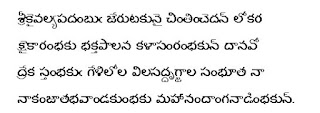
The theme behind my blog name: Pothana's Prayer

Image
Context: The medieval Telugu poets had this tradition of starting their poetic works with an “indicator poem” in which the author prays to his favorite God and also try to indicate the subject of the book, an ancient kind of “Preface”. They considered having this poem in the beginning is auspicious and the completion of the book will not have any interruptions. So, Pothana in continuation of the tradition, wrote this as the preface for the epic Bhagavatam. He prays to the beloved deity Krishna in this poem. Meaning: “I shall contemplate on attaining the Kaivalya Pada, the ultimate abode free from bondage (Vaikunta). I offer my prayers to the Protector and Harnesser of the World, the Enthusiast of the art of Devotion, the One who controls and mitigates the anger garnered by the evil, the One who with whose playful pastime had caused the creation of many Universes, which He holds in His abdomen and protects like a clay pot that holds the water and keeps it pure, the sweet blessed child ...